I recently set up an M17 ↔ AllStarLink bridge on a Raspberry Pi running AllStarLink/Debian 13.
The setup uses a separate AllStar private node dedicated to M17, while my other private node remains dedicated to DVSwitch. This keeps the M17 bridge independent from the existing DVSwitch/Analog_Bridge setup.
The bridge supports communication in both directions:
AllStar → M17
M17 → AllStar
M17 reflector connection/disconnection
DTMF control for reflector switching
M17 callsign/destination handling
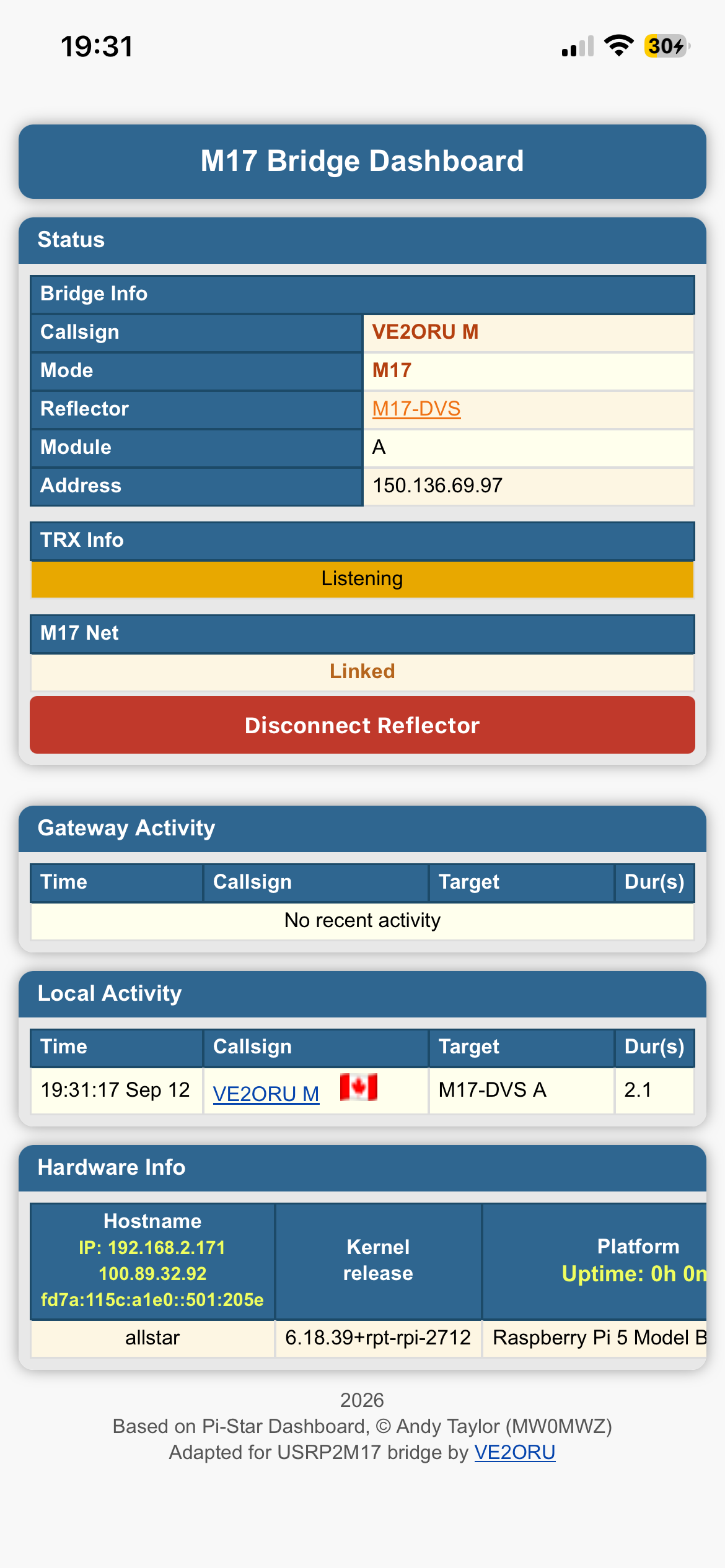
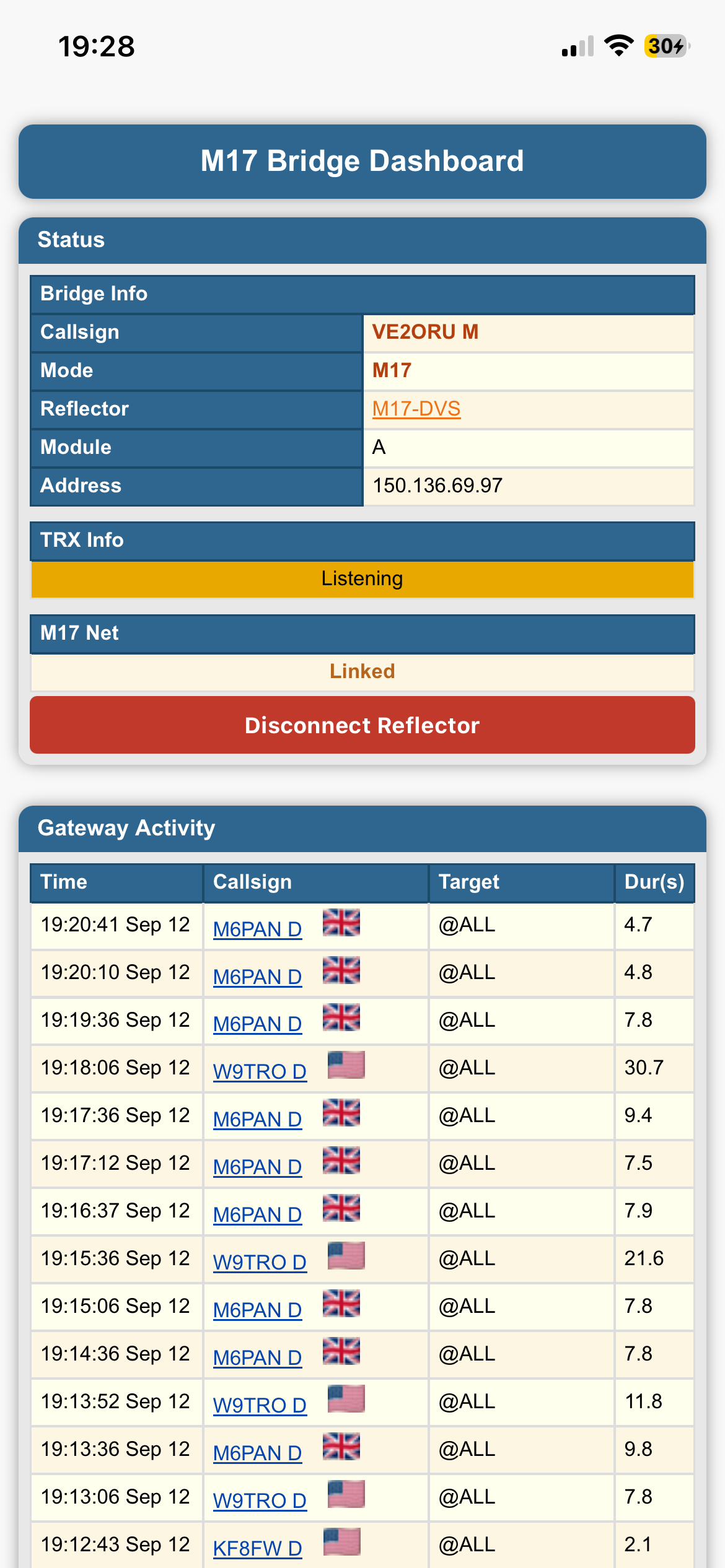
Web browser dashboard for monitoring and controlling the M17 connection
The web dashboard provides a convenient way to see the current M17 reflector and activity, including M17 callsigns and destinations.
The DTMF control concept was inspired by the Digital_Link project on GitHub from William M. Mongan, with the necessary adaptations for the AllStarLink/M17 setup.
The setup required configuring USRP2M17, AllStar routing, audio between the two systems, M17 reflector connectivity, DTMF control, and the web dashboard.
M17 is an open-source digital radio mode for amateur radio. It lets you transmit voice digitally using the open-source Codec2 voice codec. Unlike DMR or D-STAR, it isn’t tied to a particular manufacturer, so people can build their own radios, hotspots, and software around it. It also uses normal amateur radio callsigns and can be connected to internet-based networks and reflectors.
Yeah, fair point I meant more that M17 is open and not controlled by a manufacturer. DMR itself is an open standard, even though most DMR implementations and ecosystems are manufacturer-specific.
From: George Csahanin [email protected] Sent: Saturday, September 12, 2026 11:43 AM To:[email protected] Subject: AllStarLink Community Forum: M17 on Allstar Node
 I meant more that M17 is open and not controlled by a manufacturer. DMR itself is an open standard, even though most DMR implementations and ecosystems are manufacturer-specific.